
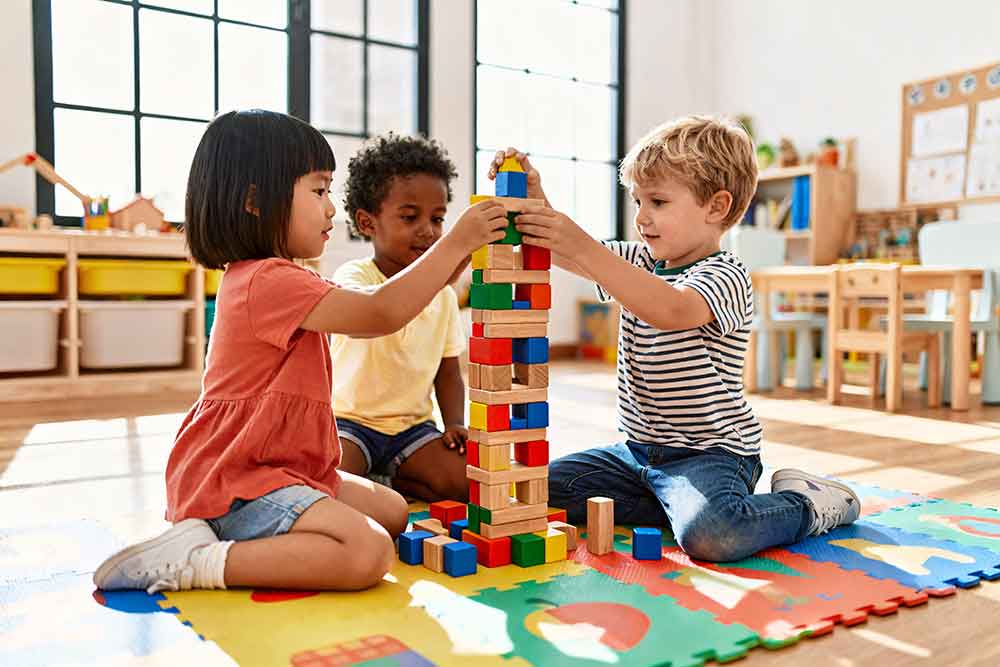
Walk into a preschool classroom and you might see children building a giant tower with blocks, pretending to run a restaurant, digging through a sensory bin, painting at an easel, or laughing together while creating an elaborate game.
To an adult, it might look like they’re “just playing.”
But look a little closer.
That block tower? They’re learning math, problem-solving, and engineering.
That pretend restaurant? They’re practicing language, social skills, counting, cooperation, and creativity.
That sensory bin? They’re exploring science concepts while strengthening the small muscles they’ll eventually use for writing.
Play isn’t what children do when they’re finished learning. Play is how young children learn.
At Pettengill Academy, we believe some of the most meaningful learning happens when children are actively exploring, creating, wondering, experimenting, and—yes—playing.
But What About Kindergarten Readiness?
This is often where parents start to worry.
Shouldn’t my preschooler be practicing letters?
Shouldn’t they be writing?
Shouldn’t they be doing worksheets to get ready for kindergarten?
Early academic skills absolutely matter. Children should have opportunities to explore letters, numbers, shapes, sounds, patterns, and early writing.
But young children don’t need to spend hours sitting at a table completing worksheets to learn those skills.
In fact, we can teach many of those same concepts through experiences that are much more meaningful to a young child.
Instead of circling the number five on a worksheet, a child can count five apples while playing grocery store.
Instead of tracing the letter S twenty times, they can make an S with playdough, find it in their name, draw it in sand, or notice it while reading a favorite book.
The learning goal may be the same.
The experience is completely different.
Play Builds Problem-Solving Skills
Imagine two children trying to build the tallest block tower they possibly can.
It falls over.
They rebuild it.
It falls again.
They try putting the bigger blocks on the bottom.
Suddenly, it stays standing.
In those few minutes, those children have experimented, made predictions, experienced failure, adjusted their strategy, worked together, and solved a problem.
No worksheet could recreate that experience.
Even better?
They probably didn’t realize they were learning at all.
Play Builds Social and Emotional Skills
Some of the most important skills children need before kindergarten aren’t academic.
They’re learning how to:
- Take turns.
- Share materials.
- Ask another child to play.
- Express their ideas.
- Listen to someone else’s ideas.
- Handle frustration.
- Solve disagreements.
- Wait.
- Compromise.
- Try again when something doesn’t work.
These skills are practiced over and over again during play.
When children play together, they’re learning how to be part of a community—and that’s an incredibly important part of being ready for school.
Play Builds Language
Listen to children during dramatic play and you’ll hear an incredible amount of language.
“You be the doctor.”
“I’m going to make dinner.”
“We need three more blocks.”
“Pretend this is our house.”
Children are constantly explaining ideas, asking questions, negotiating roles, telling stories, and learning new vocabulary.
Reading books and having conversations with adults are incredibly important for language development, but so are conversations between children.
Play gives them a reason to communicate.
Play Builds Early Math and Science Skills
Math is everywhere in play.
Children count blocks. They sort objects. They compare sizes. They recognize patterns. They measure. They talk about more and less. They experiment with shapes.
Science is there, too.
What happens when we mix these colors?
Why did this block tower fall?
Will this object sink or float?
What happens when snow comes inside?
Young children are natural scientists because they are constantly asking one very important question:
“What happens if I do this?”
Our job isn’t to give them every answer.
Sometimes, our job is simply to give them the opportunity to find out.
Play Develops the Skills Children Need for Writing
Before children can successfully write letters, their hands need to be ready.
Activities like using playdough, building with small blocks, stringing beads, painting, cutting with scissors, picking up small objects, and manipulating sensory materials strengthen fine-motor skills.
These activities might not look like “writing practice,” but they’re helping prepare children’s hands for pencils later.
Development happens in steps.
We don’t need to rush the final step when there’s so much important work happening before it.
Play Encourages Creativity
A worksheet usually has one correct answer.
Play can have a hundred.
A cardboard box can become a spaceship, a restaurant, a castle, a race car, or a house for stuffed animals.
When children have opportunities to create their own ideas instead of always following adult directions, they develop imagination, flexible thinking, and confidence.
Those skills will serve them far beyond preschool.
Does This Mean Worksheets Are Bad?
Not necessarily.
There’s a time and place for many different teaching tools.
The bigger question is whether worksheets are becoming the primary way young children are expected to learn.
At Pettengill Academy, we believe early childhood should be active, hands-on, engaging, and developmentally appropriate.
We don’t want children simply memorizing information.
We want them to understand it.
We want them asking questions.
We want them experimenting.
We want them excited to learn.
And most importantly, we want them to develop the confidence to try something new—even when they don’t know the answer yet.
“But It Looks Like They’re Just Playing…”
We understand why parents sometimes wonder what their child learned during the day.
You ask your preschooler:
“What did you do at school today?”
And they proudly answer:
“I PLAYED!”
And you might think, That’s it?
But what they may really be saying is:
I practiced sharing.
I solved a problem.
I counted.
I built something.
I used my imagination.
I learned a new word.
I made a friend.
I tried something that was hard.
I figured something out.
I learned.
That’s the magic of early childhood education.
Protecting the Power of Childhood
There will be plenty of time in a child’s life for desks, assignments, tests, and worksheets.
Early childhood is a unique window of development when children are naturally curious about everything around them.
We want to protect that curiosity.
At Pettengill Academy, we believe preparing children for kindergarten doesn’t mean turning preschool into kindergarten earlier.
It means giving children the experiences they need to become confident, independent, curious, and creative learners who are ready for whatever comes next.
So when you peek into one of our classrooms and see children building, pretending, painting, digging, laughing, experimenting, and exploring, know that something pretty incredible is happening.
They’re playing.
And they’re learning more than you might think.